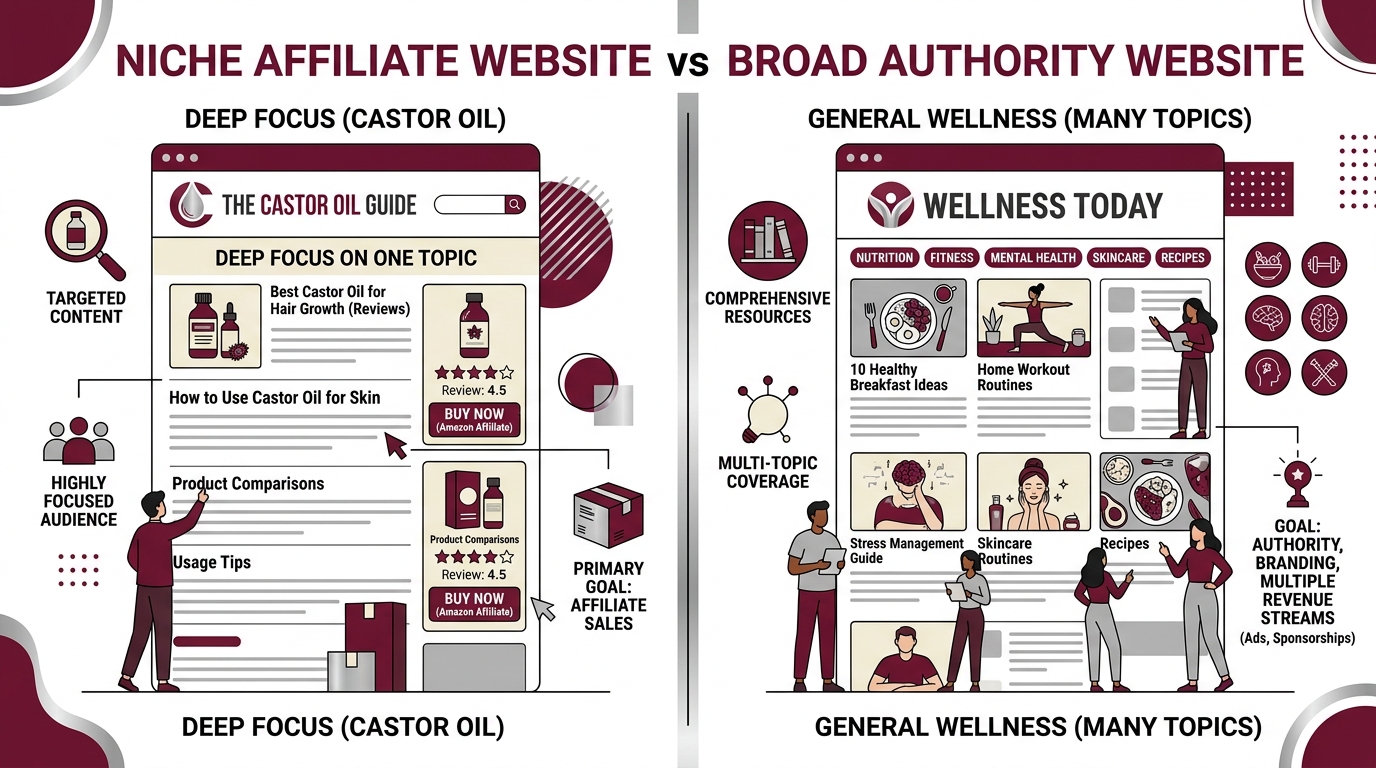
If you’re building an affiliate website, the niche site vs authority site question usually comes up early. The two terms sound like different kinds of websites, but the distinction is simpler than that. They describe how wide a topic a content site covers and how far the site is intended to grow.
For a basic explanation of the underlying model, see the “What Is a Content Site?” post. The difference here is what happens when that model is kept tightly focused versus expanded across a much larger subject.
What Is a Niche Site?
A niche site concentrates on a clearly defined topic. A website devoted to cordless drills is a simple example. It could compare drill models, explain battery types, answer questions about power and torque, and help readers decide which drill fits a particular job.
The important part is not the number of pages. There is no official page count that turns a website into a niche site. The point is that the subject stays focused enough that most of the site’s content serves the same general audience and search intent.
That focus can make an affiliate site easier to plan. Instead of deciding what to publish across an entire industry, the owner can concentrate on a smaller group of questions and products. Other examples might include home espresso machines, trail running shoes, or a particular type of software.
What Is an Authority Site?
“Authority site” is a common industry term rather than an official website classification. It generally refers to a site that covers a much broader subject and builds depth across several related areas.
Take home coffee as an example. A site that begins with espresso machines could also cover grinders, brewing methods, coffee makers, beans, scales, storage, and other equipment. The individual topics are different, but they still belong to the same larger subject.
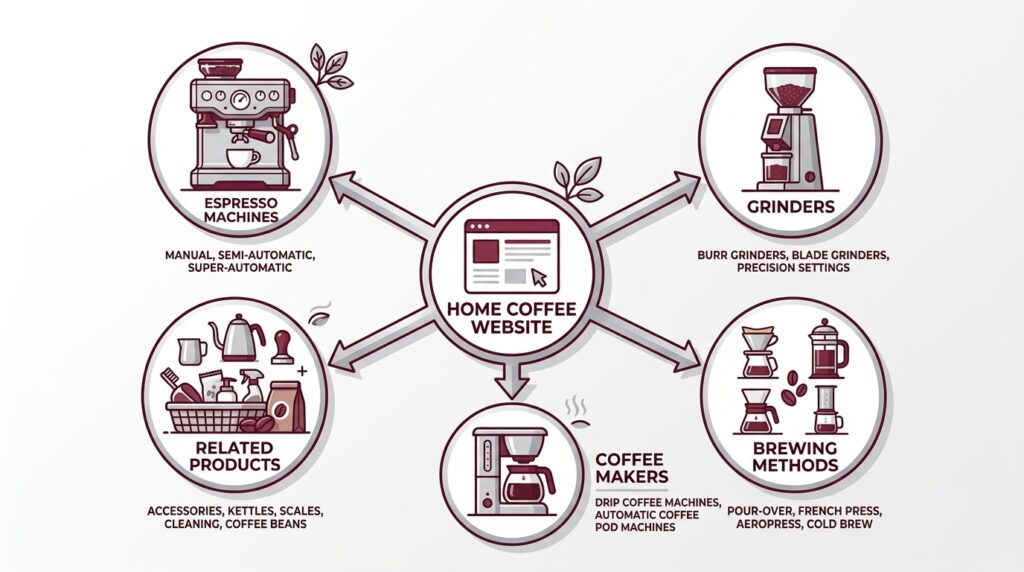
That wider range creates more ways to attract visitors and more options for monetization. An affiliate site might recommend products, earn from display advertising once traffic grows, and build an email list that brings readers back to the site.
It also takes more work. More topics mean more research, more pages to maintain, and more decisions about where a new article belongs. A broader site can eventually become a substantial resource, but it usually takes longer to build than a tightly focused one.
Page Count Doesn’t Tell the Whole Story
Page count is often used as shorthand for the difference between a niche site and an authority site. It can be a rough clue, but it is not a definition.
A site with 20 strong articles about running shoes can be a perfectly legitimate niche site. Another site with 80 articles might cover running shoes, watches, headphones, hydration gear, training plans, and other parts of running. The second site is broader, even though the numbers alone don’t tell you why.
This is why fixed rules such as “a niche site has 10–30 pages” or “an authority site needs 100 pages” should be treated cautiously. There is no industry body handing out certificates at page 101. What matters more is the range of topics the site covers and whether those topics still make sense together.
The Difference Matters for Affiliate Marketing
For affiliate marketing, the choice affects how products, content, and traffic fit together.
A focused software site, for example, might concentrate on one type of tool and publish comparisons, alternatives, setup guides, and buyer-focused articles around it. The affiliate offers can stay closely connected to what readers are already researching.
A broader site about business software could cover project management, email marketing, accounting, website builders, customer relationship tools, and other categories. That creates more potential affiliate offers, but it also means the publisher has a much larger subject to understand and cover well.
There is a trade-off here. A focused site gives the publisher fewer moving parts and a clearer audience. A broader site gives the publisher more room to add related topics and more than one source of revenue. Neither automatically produces better results.
Can a Niche Site Become an Authority Site?
Yes. A site can start with a tight subject and expand when there is a good reason to do so.
Consider a site that starts with running shoes. It might begin with shoe comparisons and guides for different types of runners. If readers also need information about GPS watches, running headphones, hydration products, or other closely related gear, those topics could become natural additions.

The same thing can happen in other areas. A personal finance site might begin with credit cards and later cover banking, budgeting, saving, and investing. At some point, the site is no longer focused on one product category, even though it grew from a much smaller starting point.
Expansion does not have to happen, though. If a focused site covers its subject well and has enough demand to support it, staying focused can be a perfectly reasonable choice. A small site is not automatically an unfinished version of a larger one.
Which Approach Should You Start With?
The better starting point depends mostly on what you want to build and how much work you want the site to involve.
A niche site may suit someone who wants to concentrate on a clearly defined topic, keep the number of moving parts down, or get an earlier indication of whether a particular set of keywords and affiliate offers has potential.
A broader authority-style site may suit someone who wants to build around a larger subject and is prepared to keep adding related material over a longer period. It offers more room for different products, search topics, and revenue sources, but that room comes with more work.
There is also a middle ground. A site can begin with one well-defined area and expand only when the next topics are genuinely connected. That avoids trying to cover an entire industry before there is a reason to do so.
Niche Site vs Authority Site: Which Is Better?
The niche site vs authority site choice is less about picking a winner and more about choosing the size of the subject you want to take on.
A focused site can be easier to plan and keep coherent. A broader site can give an affiliate publisher more room to grow into related topics and revenue sources. Starting with a smaller subject does not lock a site there forever, and starting broad does not guarantee that the extra pages will pay off.
The sensible test is whether the topic gives you enough good questions to answer, products or services that genuinely fit those questions, and room to keep publishing without stretching the subject beyond recognition. If those pieces are there, either approach can work.
For anyone comparing a niche site vs authority site, that is probably the more useful question to settle first: not “Which one is better?” but “What can this site realistically cover well?”
Is a niche site or authority site better for affiliate marketing?
Neither is automatically better. A niche site keeps the subject and affiliate offers tightly focused, while a broader authority-style site can cover more topics and support more revenue sources. The better fit depends on the subject and the amount of work the publisher wants to take on.
How many pages does a site need to be considered an authority site?
There is no official page-count requirement. Page count can give a rough idea of size, but the more important difference is how broadly the site covers its subject and how closely the topics relate to one another.
Can a niche site be sold once it’s built?
Yes. Focused content sites can be bought and sold, just like broader sites. Their value depends on factors such as traffic, earnings, content quality, search rankings, and how dependent the site is on a particular affiliate program or traffic source.