How long does affiliate marketing take to make money? If you’re typing that into Google at midnight after reading yet another ‘I made $10K in my first month’ post, the honest answer is: longer than that, and probably not the way you’re picturing it. The standard response, ‘it depends,’ followed by a list of variables nobody explains, doesn’t help anyone plan anything.
It does depend on your traffic source, your niche, and whether your content is any good. Those three things mean there’s no single number to promise. But it’s possible to map out honest ranges for each path, and that’s a lot more useful than a shrug.
If you need money fast, this isn’t it. The first year is closer to planting than earning, and treating it that way makes the failure statistics a lot less scary.
Why the Timeline Question Is Hard to Answer Honestly
Most guides either throw out a range so wide it’s useless (‘3 months to 3 years, results may vary!’) or point to the one success story everyone’s seen shared a hundred times. Think about who’s most motivated to answer this in public: someone selling a course, who needs the number to sound exciting, or someone who quit at month six and is still annoyed about it, who needs it to sound impossible.
Neither one is lying, exactly. They’re just the two extremes, and almost everyone lands somewhere in the middle. Nobody posts about the middle because there’s nothing dramatic about it. It’s slower than the success story, and it’s not as bad as that guy who quit at month six made it sound.
Why the Path You Pick Changes the Timeline
Not everyone takes the same road to make money with affiliate marketing. Email marketing can start paying off within months if you’re already growing a list. Paid traffic can send a sale on day one, though turning that into real profit takes some skill with the numbers. Social platforms can spike fast and go quiet just as fast, since none of it compounds the way search traffic does. Organic search is the slowest of the four to get moving, and it’s also the one most beginners build on, hepreneur included. The rest of this post is about that path.
So how long does affiliate marketing take to make money through organic search? New websites go through a quiet period early on where they barely appear in search results, regardless of how good the content is, while search engines get a feel for the site — the online equivalent of being the new hire nobody hands anything important to yet. Most content sites start seeing real traffic somewhere between months 9 and 18, assuming steady publishing and a niche that isn’t dominated by huge established sites. ‘Meaningful’ here means enough to bring in occasional affiliate commissions, not enough to replace income. That typically comes later, somewhere in the 18–30 month range for sites that keep at it.
What’s Happening in the Quiet Months
The first 6–12 months feel like nothing is happening, income-wise. But something is happening. It’s just invisible from the outside. Google is slowly working through the content, figuring out what the site is actually about, and deciding how much to trust it. Every post that links to another one adds to that picture. Eventually Google stops seeing forty separate blog posts and starts seeing one site that clearly knows this topic inside and out.

This is also where the delay works in your favor. A post published in month 2 might not rank until month 10, but once it does, it keeps bringing in traffic without any more work from you. The same happens with posts from months 3, 4, and 5. So when traffic finally kicks in, it’s often several posts ranking at once, not one, which is why content sites tend to jump instead of climb slowly.
Here’s the strange part: work you did in February can end up paying you in October. Coming from a job or freelance work, where Friday’s effort turns into Friday’s paycheck, that gap messes with your head a little. You did the work. The money’s just running late.
What Speeds This Up or Slows It Down
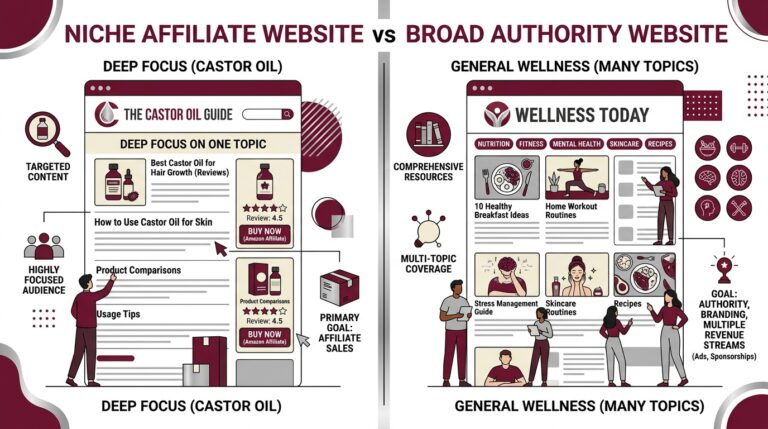
Niche competition changes everything here. A site answering questions in a thin, under-covered corner of a niche (where the current top results are outdated or don’t really answer the question) climbs faster with less content than one fighting for space in a crowded niche. Affiliate marketing itself is a brutally competitive niche. Picking a narrow slice of it gives a new site a real shot early on; trying to cover the whole thing just puts it in the same race as everyone else.
Content that answers the question wins over content that’s just there. Ten posts that genuinely answer a specific question will outrank fifty thin ones skimming the surface of a broad topic. The ‘just publish constantly’ advice sticks around in MMO circles because it occasionally works, usually on searches so obscure that almost nothing else is competing for them, but it’s not something to build a lasting site on.
There’s also a difference between a site that’s clearly still active and one that stopped posting eight months ago — and that has nothing to do with post count alone. One solid post a week for a year and a half adds up to something very different from a site that posts ten times in a week, then goes dark for two months. Every new post is also a chance to link back to the old ones and tie the whole site together.
Picking one topic and sticking to it for a while helps too. A brand-new site covering ten categories at once just looks confused — to Google, and to anyone who lands on it. Twenty posts about one specific thing tell a much clearer story than twenty posts about ten different things, and clearer stories rank. It’s tempting to cover everything in week one. Don’t.
What Realistic Income Milestones Look Like
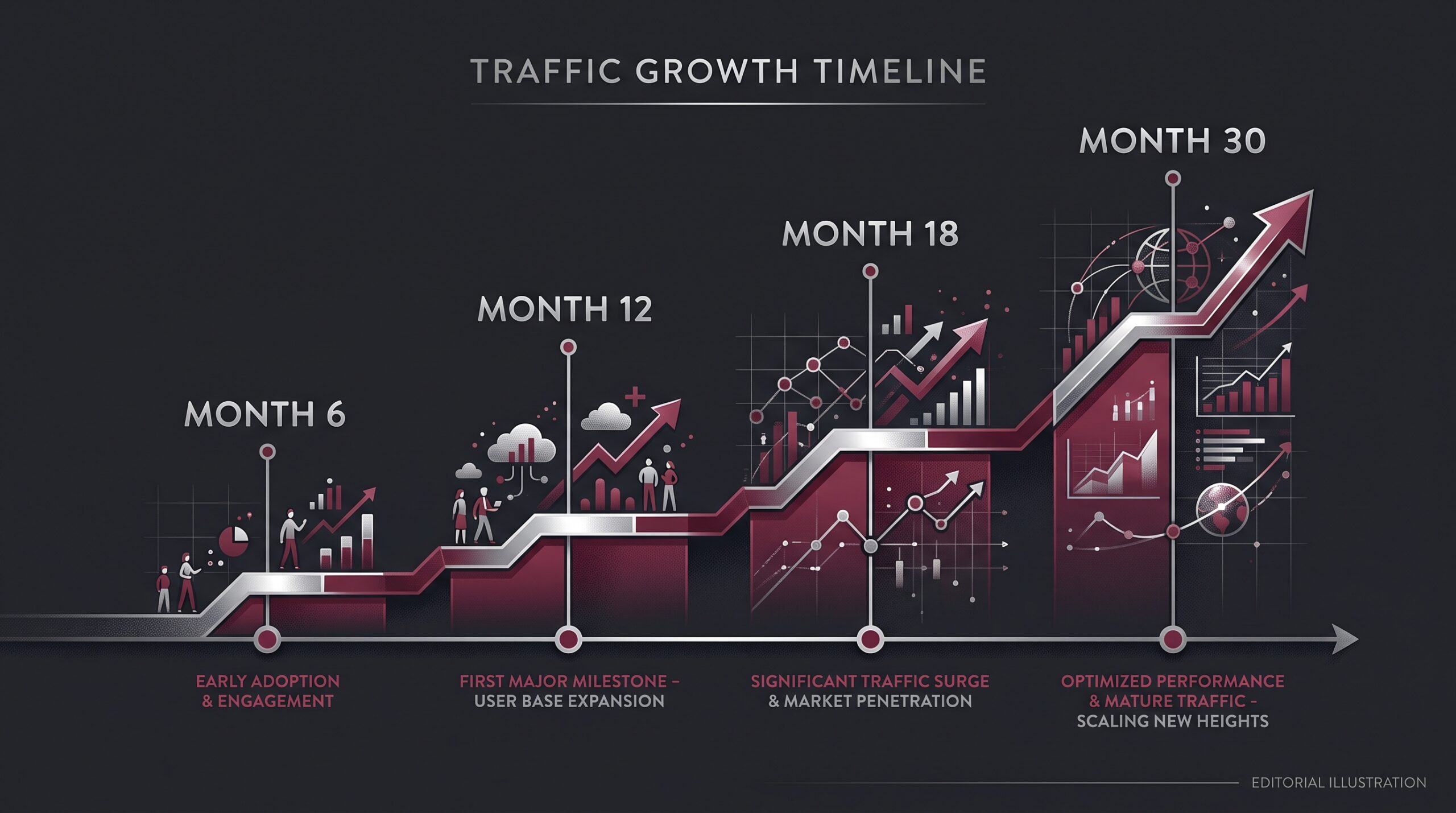
Month 1–6: Near-zero organic traffic. Possibly some referral or social traffic if you’re promoting actively. Income from organic sources: negligible. This is normal, not a sign that anything’s wrong.
Month 6–12: Early rankings start appearing for lower-competition queries. Traffic begins, usually in the dozens to low hundreds of monthly visitors. First occasional affiliate commissions are possible but inconsistent. AdSense earnings at this stage are typically in the single digits per month.
Month 12–18: For sites publishing on a steady schedule with reasonable niche selection, this is where organic traffic starts to compound noticeably. Monthly visitors can reach the low thousands. Affiliate commissions become more regular — $50–$200/month is a realistic range for a well-targeted site in a moderate-commission niche. Not significant income, but confirmation that it’s working.
Month 18–30: Sites that have kept at it (building out clusters of posts that all link back to each other around the same subject) start seeing solid results. Monthly traffic in the thousands to tens of thousands. Affiliate income in the $500–$2,000/month range is achievable in reasonable commission niches. Display advertising starts pulling in decent money alongside affiliate income.
Beyond month 30: The ceiling opens up. Sites that have spent two-plus years building trust with search engines, picking up links from other sites, and growing an email list alongside their organic traffic are in a completely different position. Income depends heavily on your niche and how much of your content targets people who are ready to buy, but $3,000–$10,000/month is within reach for well-run sites in decent niches. None of it happens on the timeline the gurus promise, which is exactly why so few people are still around to see it.
The Survival Rate Problem
Take a look at the affiliate marketing ‘failure rate’ and you’ll see a number above 90% — no typo. Read that as ‘almost everyone fails, so why bother,’ and it sounds like a reason to quit before you start. But that number mostly counts how many people quit before finding out whether a content site actually works, which means a lot of them probably quit too soon.
Most people quit within the first six months. A lot more are gone by the one-year mark, usually right around when publishing stops feeling new and the traffic still isn’t there. The ones who make it to 18 months without quitting are a small group. But inside that group, the odds look nothing like that 90% number, because nobody warned them what month seven would feel like.
Whether affiliate marketing actually pays off is one question. The tougher one is whether you can keep publishing for a year and a half while you’re seeing almost nothing for it — and that’s worth being honest with yourself about before you start.
So: how long does affiliate marketing take to make money? For a content site running on organic search, plan on 12–18 months before traffic means anything, and 18–30 before the income feels reliable. Most people who quit do it around month nine — right before any of this would have started paying off for them.
The next post looks at the first real traffic challenge: how to get your first 1,000 visitors to a new site before organic search has had time to kick in.
How long does it take to make money with affiliate marketing?
For a content site using organic search, most sites see meaningful traffic between months 9 and 18, and consistent affiliate income between months 18 and 30. The timeline is shorter with email marketing or paid traffic but those approaches come with their own tradeoffs. Content quality and niche competition matter more than time spent.
Can you make money with affiliate marketing in 3 months?
It’s possible but unlikely from organic search alone — new domains typically take 6–12 months before search engines begin ranking their content in a noticeable way. With email marketing to a list built at the same time, or paid traffic with the right economics, faster results are possible. Most beginners who see fast results are either in a very low-competition niche or using paid traffic.
Why does affiliate marketing take so long?
The main reason is how search engines evaluate new domains. There’s a natural period where rankings are held back no matter how good the content is, while Google gets a feel for what the site is about and whether it can be trusted. Publishing consistently over 12–18 months matters because each post adds to an archive that search engines take more seriously as the site ages.