Can you actually make money with affiliate marketing? Google it and you’ll get two answers: a course seller telling you yes, obviously — buy my system. And a burned-out redditor telling you no, it’s dead, don’t bother. Both of them are lying a little.
Full disclosure: affiliate marketing is part of what hepreneur is building too. So there’s no reason to sugarcoat this — get it wrong and nobody wins, us included.
Here’s what decides it: how much you can realistically expect to make, how long it takes to get there, and what kind of site pulls it off.
What Affiliate Marketing Is
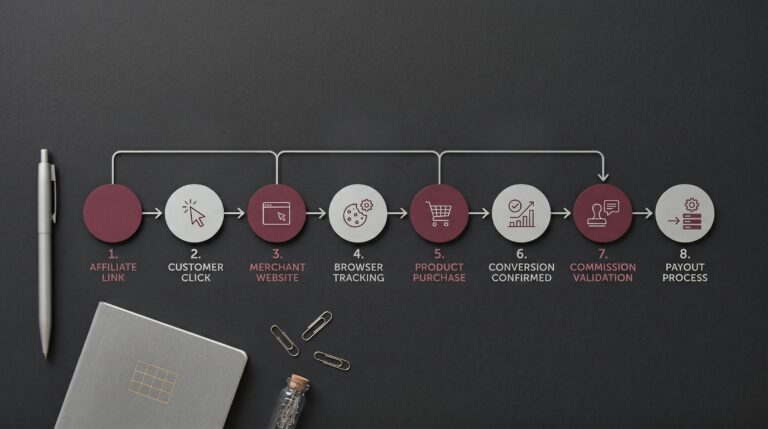
Affiliate marketing means promoting someone else’s product and earning a commission when a sale, or sometimes a lead or a click, happens through your referral link. You don’t handle inventory, customer service, or fulfillment. Your job is to send people who are likely to buy to the merchant.
Most affiliates do this through content: blog posts, review articles, comparison pages, YouTube videos, or email newsletters. Some use paid advertising. The content-site model, building a blog that ranks in search engines and pulls in traffic on its own, is what most people mean when they talk about affiliate marketing as a long-term income strategy.
Commission rates vary widely. Physical products through Amazon Associates typically pay 1–4%. Software and digital products through networks like Impact or ShareASale can pay 20–50%, sometimes recurring monthly. What you’re promoting matters almost as much as how much traffic you get: a site sending 10,000 visitors to $5 kitchen gadgets is working a lot harder than one sending 1,000 to $40-a-month software.
What Does ‘Making Money’ Mean Here?
‘Making money’ can mean $50 a month or $50,000 a month — and both figures show up in the same forum thread like they’re equally likely. That’s usually where the question of whether you can actually make money with affiliate marketing goes fuzzy.
Affiliate marketing income varies enormously. A small number of sites earn a lot, and a lot of sites earn little or nothing. That’s not unusual — most content-based businesses work the same way. Where you end up mostly depends on a few specific choices: your niche, your content, and how consistently you publish.
Public income reports and surveys give a rough sense of what this looks like in practice. Sites in the first 12 months tend to earn close to nothing from organic traffic (the indexing lag is real). Sites that are 6–18 months old with 20–50 well-targeted posts start seeing modest income in the $100–$500/month range. Sites past the two-year mark with consistent output have a realistic shot at $1,000–$5,000/month depending on niche and commission structure. The top tier, $10,000/month or more, exists, but only a small percentage of affiliate sites ever get there. That’s the number nobody puts in the screenshot.
The key word throughout is ‘organic.’ Paid traffic can speed things up, but it costs money. That eats into what you keep. Most affiliate marketing that’s realistic for beginners runs on content and SEO, which means the timeline is long no matter how hard you work in month one.
The 12–18 Month Window No One Tells You About
New content sites almost universally go through a low-traffic phase regardless of content quality — new, unfamiliar sites just get treated that way at first. Google needs time to figure out what a site is about, work through what’s there, and decide how much to trust it before ranking it well. That process plays out over months, not weeks.

In practice, most content sites take 12–18 months before organic search traffic becomes meaningful, and that’s only if the content is good. hepreneur breaks down that exact timeline question separately. A site publishing weak, generic posts may never break out. A site publishing specific, well-researched content in a niche with manageable competition has a realistic shot at ranking by month 9–12.
This is a big reason the affiliate marketing failure rate looks so high — most of it isn’t the model. It’s people quitting too early. Most stop around month four, right before things start to turn. The sites that stick it out for 18 months are a small group, but within that group, way more of them succeed than the overall failure-rate numbers would suggest.
What Decides How Much You Make
Start with the niche, because the math there is brutal and nobody talks about it. Sell $5 kitchen gadgets and you need roughly 10x the traffic to hit $1,000 a month compared to selling $30–$100 software or subscriptions. Same work building the site, wildly different ceiling. Most people pick a niche because they’re interested in it, then wonder later why the income never caught up.
Then there’s what you write. A post explaining how something works pulls in people who are just curious — they read, they leave, they don’t buy. A post comparing two products, or answering ‘which one should I get,’ pulls in people who already have their card out. Write only the first kind and you’ll grow an audience that never converts.
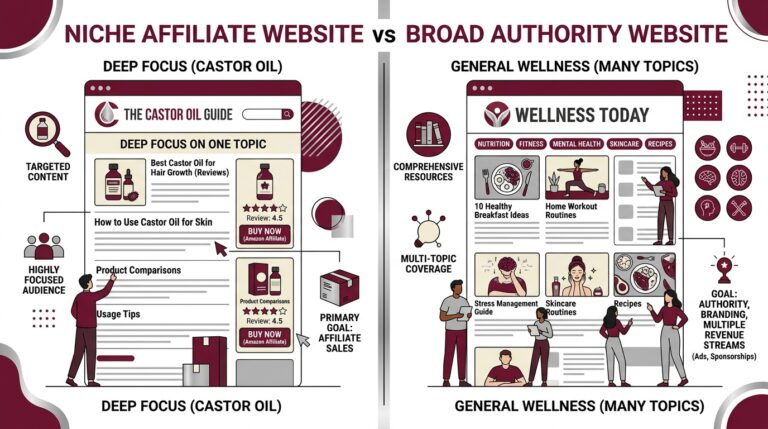
Staying in one lane helps too. Google notices when a new site sticks to one subject instead of bouncing around — 30 focused posts on the same topic will usually beat 30 posts spread across five unrelated ones. Not always, but often enough to bet on.
Consistency is the one people blow off, and it costs them the most. More posts alone won’t rank you higher. What it does is prove to Google the site’s still alive, and it hands you another chance to link back to what you’ve already published. One solid post a week for a year adds up to something real. Fifty-two posts dumped in a month and then nothing doesn’t.
What the Honest Answer Looks Like
Affiliate marketing can make you real money. It just won’t be quick, it won’t be passive from day one, and it won’t happen without picking your niche and your content on purpose instead of by accident. Take it seriously and there’s a real ceiling here. Need money in the next 90 days? Wrong tool for the job.
The sites that earn aren’t doing anything exotic. They picked a decent-commission niche, wrote content that matched what buyers were already searching for, stuck with it longer than most people bother to, and treated year one as an investment instead of a paycheck.
So, can you actually make money with affiliate marketing? Yes. But ‘making money’ at month three looks nothing like ‘making money’ at month eighteen, and what you picked to promote will shape the outcome more than how hard you worked.
Whether affiliate marketing works isn’t really up for debate anymore — you just read the numbers. What’s left is your version of it: the niche you picked, the commission attached to it, the content you’re planning to write. Get specific about those three, and you’ll know more than most of the people still arguing about whether the whole model’s a scam.
Is affiliate marketing a fast way to make money?
Most content-based affiliate sites take 12–18 months before organic search traffic becomes meaningful. That assumes regular publishing and a niche that isn’t already dominated by bigger sites. Paid traffic can speed things up, but it isn’t free — you’re just trading time for cash.
What percentage of affiliate marketers actually make money?
Nobody tracks this across the whole industry, but surveys from publishers suggest a lot of affiliate sites earn little or nothing in their first year. The ones that stick with it past 18 months tend to do a lot better than that overall number suggests.
Is affiliate marketing still worth starting in 2026?
It depends on what ‘worth it’ means for your situation. As a long-term content business with the right niche economics and grounded timeline expectations, yes. As a quick income strategy, no — the organic search timeline is too long for anyone who needs money fast.